Five animated videos showing how GCSE maths can be used in real-world engineering scenarios
Each video takes a maths topic from the curriculum and moves it from the textbook to the shop floor at ‘Ashfield Engineering’. They demonstrate how maths helps engineers measure, calculate, interpret information and solve practical problems in real world scenarios.
Captioned, self-contained and easy to use in lessons and at home, they help students understand not just how to do maths, but why it matters.
A bracket passes a dimensional check and a weld check. The tree is built branch by branch, the four routes are multiplied out, and the answer lands as 69 rejects per 1,000 a week, a scrap figure a production manager would recognise.
Topic
Probability trees
Tier
Foundation and Higher
Covers
Tree diagrams for two independent events; multiplying along branches; the complement rule; converting a probability into an expected frequency.
Fits with
New ground. Nothing in the existing five modules touches probability, so this is the front door to the strand.
Questions
4 questions, 12 marks, on the video page with the answers
Ten carbide tools are logged for cutting speed against tool life. The cloud of points is plotted, the line of best fit is drawn and measured, and its gradient turns into a sentence a setter can act on: every extra metre per minute costs about half a minute of tool life.
Topic
Scatter graphs and correlation
Tier
Foundation and Higher
Covers
Plotting bivariate data; describing correlation; drawing and using a line of best fit; interpolation and extrapolation; correlation is not causation.
Fits with
Sits directly alongside Module 04, Setting CNC Cutting Speeds: same machine, same section, same numbers. Show the video first, then run the module.
Questions
4 questions, 11 marks, on the video page with the answers
An inspector writes 24.6 mm and 24.8 mm. The video shows why those are bands rather than sizes, then combines them the awkward way round to get the greatest and least possible clearance, and checks both against the drawing tolerance.
Topic
Upper and lower bounds
Tier
Higher (accessible at Foundation to the end of step 2)
Covers
Error intervals from rounding; inequality notation; upper and lower bounds; combining bounds in a calculation, including subtraction.
Fits with
Strengthens the measurement work in Module 01 (Footbridge Truss) and Module 02 (Batching a Concrete Base), where measured values are currently treated as exact.
Questions
4 questions, 13 marks, on the video page with the answers
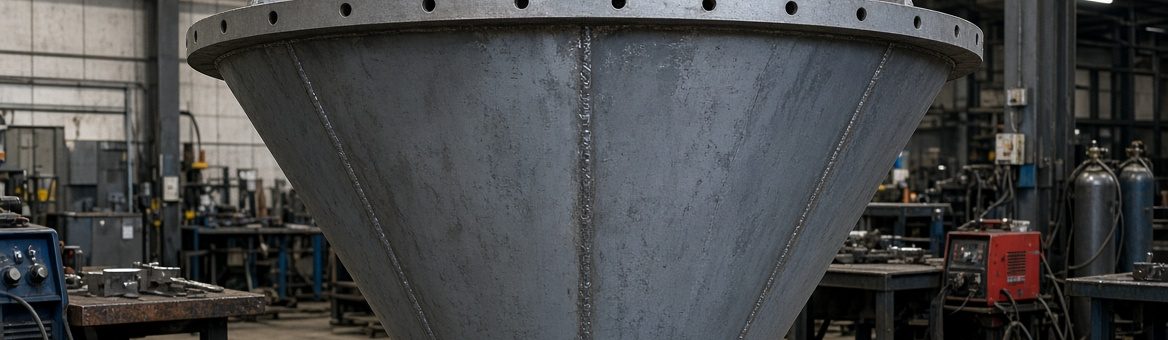
A quarter-scale hopper model is scaled up. Lengths go ×4, the plate order goes ×16, and the mass goes ×64, which puts the finished hopper 76 kg over the crane rating. The consequence is what makes k³ stick.
Topic
Similar shapes and scale factors
Tier
Higher (length scale factor is Foundation)
Covers
Scale factors between similar shapes; the relationship between length, area and volume scale factors; working back from an area or volume ratio to the linear scale factor.
Fits with
Extends Module 05, Sizing a Hydraulic Tank, where surface area and volume are calculated once. This video asks what happens when the whole tank is scaled.
Questions
4 questions, 10 marks, on the video page with the answers
Sixty welds survive only as a grouped tally. The video builds the midpoint and f × x columns on screen, then makes the point that Σfx is not just a stepping stone. At 1,480 minutes it is the week’s labour budget.
Topic
Averages from grouped data
Tier
Foundation and Higher
Covers
Grouped frequency tables for continuous data; midpoints; estimating a mean; identifying the modal class and the class containing the median; understanding why the mean is an estimate.
Fits with
New ground, and the natural partner to video 02. Together they cover the two statistics topics missing from the current module set.
Questions
4 questions, 11 marks, on the video page with the answers
Videos 02 and 04 sit alongside modules that are already built, and work as the way into them. Videos 01, 02 and 05 open the probability and statistics strand, which the current module set does not cover at all. That is the largest gap flagged on the curriculum planning map. Each video ends on an unanswered question and holds there, so it can be stopped and picked up as a starter or a plenary.